
Rupture Disc Applications
임직원 모두 하나 된 마음으로 신뢰가 기본인 회사를 만들어 갑니다.
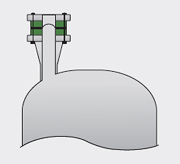
When a rupture disc device is installed as the sole pressure relief device, the specified burst pressure shall be at or below the MAWP of the vessel, and the device shall have sufficient relieving capacity to prevent the pressure from exceeding 10% or 3 psi above the MAWP, whichever is greater.
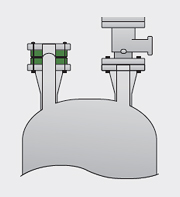
When multiple pressure relief devices are installed, at least one device shall be set at or below the MAWP (Maximum Allowable Working Pressure) of the pressure vessel. Except for fire exposure conditions (fire case), the set pressure of the remaining devices shall not exceed 105% of the MAWP. The combined relieving capacity of the devices shall be sufficient to prevent the vessel pressure from rising more than 16% or 4 psi above the MAWP, whichever is greater, during relieving conditions.
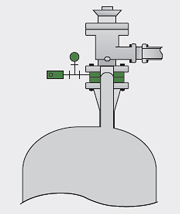
A rupture disc device may be installed between the process and a pressure safety valve or on the outlet side of the safety valve, provided that the required relieving capacity is ensured. Such an arrangement is intended to prevent leakage through the pressure safety valve and to protect the valve from corrosion or process contamination. When a rupture disc device is installed on the inlet side of a safety valve, the rated relieving capacity of the safety valve shall be taken as 90% of the capacity marked on the valve nameplate, unless the combination has been tested under the same service conditions, in which case the actual tested capacity may be used. When used in combination with a safety valve, the rupture disc shall not interfere with the proper operation of the safety valve upon bursting. Adequate space shall be provided between the safety valve and the rupture disc, and a pressure-monitoring device capable of detecting pressure build-up between the rupture disc and the safety valve shall be installed. * Pressure Gauge, Pressure Switch, Excess Flow V/V, etc.
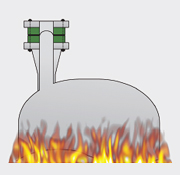
Where additional hazards may arise due to fire or other unexpected external heat sources, supplementary pressure relief devices shall be provided to protect the vessel against damage resulting from overpressure. In such cases, the relieving capacity shall be sufficient to prevent the vessel pressure from rising more than 21% above the MAWP. The set pressure of the pressure relief device shall not exceed 110% of the MAWP. For vessels used for the storage of liquefied compressed gases at ambient temperature, and not provided with a permanent supply connection, where protection against fire or other external heat sources is the primary purpose of the pressure relief device, the relieving capacity shall be sufficient to prevent the pressure from rising more than 20% above the MAWP.